# Getting Started
source: https://developer.mastercard.com/ethoca-consumer-clarity-for-merchants/documentation/getting-started/index.md
Full integration with Ethoca's Merchant Transaction API proceeds in four phases:
* [Discovery](https://developer.mastercard.com/ethoca-consumer-clarity-for-merchants/documentation/getting-started/index.md#discovery-phase)
* [Integration](https://developer.mastercard.com/ethoca-consumer-clarity-for-merchants/documentation/getting-started/index.md#integration-phase)
* [Testing/Verification](https://developer.mastercard.com/ethoca-consumer-clarity-for-merchants/documentation/getting-started/index.md#testing-and-verification-phase)
* [Deployment](https://developer.mastercard.com/ethoca-consumer-clarity-for-merchants/documentation/getting-started/index.md#deployment-phase)
Your Ethoca sales representative and Ethoca integration contact are available to assist at any point in the process. For integration support, contact the [Ethoca Customer Service Team](mailto:customerservice@ethoca.com).
Note: Ethoca's Development team occasionally releases updates to the APIs.
If you receive documentation but are unable to complete development in a timely manner, check back with your Ethoca integration contact to make sure a newer version of the documentation hasn't been made available. They'll make every attempt to provide the updated documentation once it becomes available.
For more information about upcoming updates and recent ones, see the [Announcements](https://developer.mastercard.com/ethoca-consumer-clarity-for-merchants/documentation/announcements/index.md) and [Release History](https://developer.mastercard.com/ethoca-consumer-clarity-for-merchants/documentation/release-history/index.md) sections.
This map provides you with a clear, end-to-end view of the full integration journey, outlining each key phase to support a smooth onboarding experience:
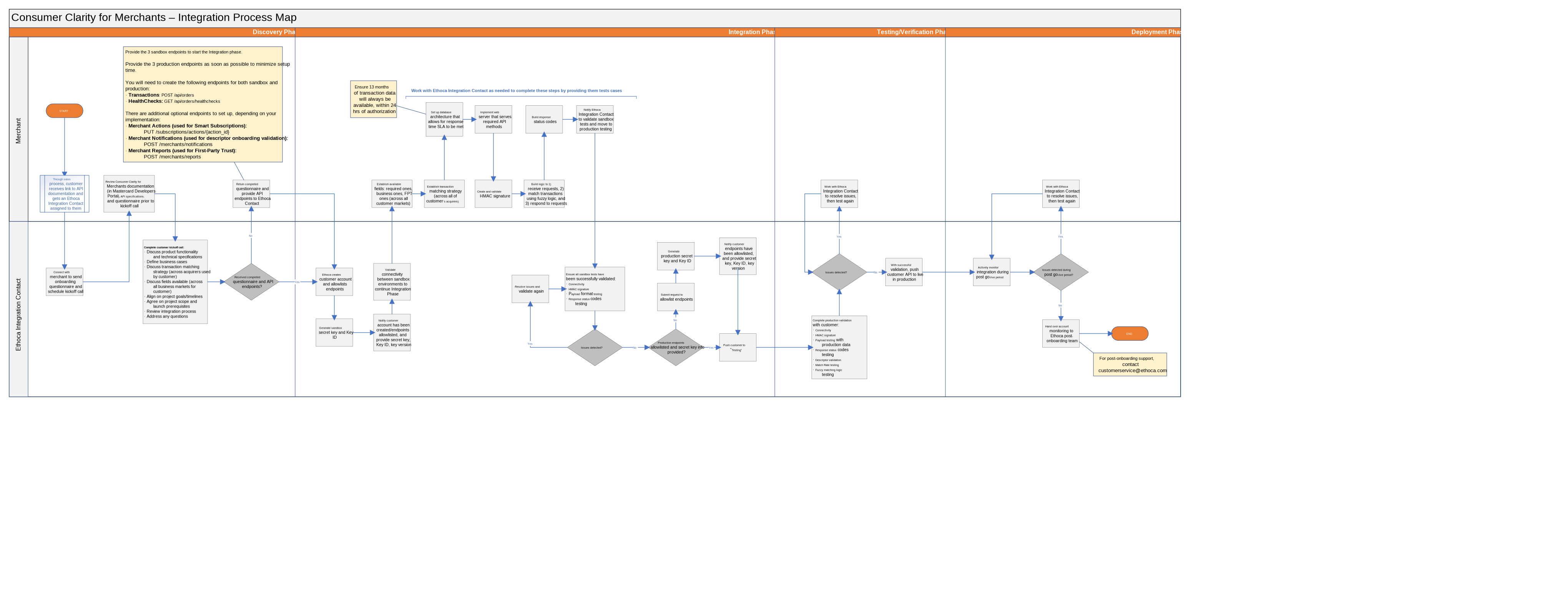
## Complete Integration Workflow {#complete-integration-workflow}
Consumer Clarity for Merchants uses a merchant-hosted integration model. Ethoca sends requests to the endpoints you implement, and your application validates each request, locates the applicable transaction or subscription, and returns the required response.
Use this workflow as a guide through the detailed phases on this page:
1. **Complete discovery and onboarding.** Confirm the products, use cases, endpoints, fields, launch requirements, and project scope with your Ethoca integration contact.
2. **Prepare your environments.** Implement the applicable merchant endpoints in both sandbox and production and complete endpoint allowlisting.
3. **Configure authentication.** Validate the authentication information on requests received from Ethoca.
4. **Build request-processing workflows.** Match incoming requests to the correct transaction or subscription and return a valid JSON response.
5. **Complete sandbox and production validation.** Validate connectivity, authentication, payloads, status codes, transaction matching, and performance requirements.
6. **Deploy and monitor the integration.** Complete final production verification and work with your Ethoca integration contact during post-launch monitoring.
## Discovery Phase {#discovery-phase}
Through the sales process, a dedicated Ethoca integration contact will be assigned to you. They'll be your reliable point of contact throughout the project, helping ensure a seamless onboarding experience through expert guidance and timely support when needed.
### Kickoff meeting {#kickoff-meeting}
In the Discovery phase, your Ethoca integration contact provides you with the onboarding questionnaire and schedule a kickoff meeting with your technical team, business owners, and any other key stakeholders you'd like to include.
This kickoff meeting is an opportunity to:
* Discuss product functionality and technical specifications
* Define business cases
* Align on project goals and timelines
* Agree on project scope and launch prerequisites
* Review the integration process
* Answer any questions you may have
To get the most out of this initial meeting, first review the following documentation:
* [Consumer Clarity for Merchants documentation](https://developer.mastercard.com/ethoca-consumer-clarity-for-merchants/documentation/index.md)
* Merchant Transaction API Specification
* **View:** [API Reference](https://developer.mastercard.com/ethoca-consumer-clarity-for-merchants/documentation/api-reference/index.md#apis)
* **Download:** [merchant_spec_4_0_0.yml](https://static.developer.mastercard.com/content/ethoca-consumer-clarity-for-merchants/swagger/merchant_spec_4_0_0.yml) (150KB)
* Clarity: Merchant Onboarding and Integration Questionnaire
## Integration Phase {#integration-phase}
To begin the Integration phase after the kickoff meeting, complete the questionnaire and send it to your Ethoca integration contact (if you haven't done so already).
### Environment setup {#environment-setup}
Warning: Responses to API requests may include personally identifiable information (PII). Ethoca classifies this data as "Regulated-Classified". Consistent with Ethoca's policy on Applications and Systems Development and Maintenance, Ethoca requires that customers not deliver production data to the sandbox environment at any time.
Use the following table to determine which endpoints to implement in both sandbox and production:
| Endpoint | Purpose | When required |
|------------------------------------------|-------------------------------------------------------------------|--------------------------------------------------------------|
| `POST /api/orders` | Receive transaction and order inquiries from Ethoca. | Required for the core Merchant Transaction API integration. |
| `GET /api/orders/healthchecks` | Allow Ethoca to monitor endpoint availability. | Required for the core Merchant Transaction API integration. |
| `PUT /subscriptions/actions/{action_id}` | Receive and process a cardholder's requested subscription action. | Required only for Smart Subscriptions. |
| `POST /merchants/notifications` | Receive descriptor-onboarding processing results. | Required only when descriptor onboarding validation applies. |
| `POST /merchants/reports` | Receive First-Party Trust reports. | Required only for First-Party Trust. |
While only the sandbox endpoints are required at this point, we recommend you provide your production endpoints now if possible. This minimizes the time needed for production launch later in the process.
For more information, please see the [API Reference](https://developer.mastercard.com/ethoca-consumer-clarity-for-merchants/documentation/api-reference/index.md) section.
### API secret key generation {#api-secret-key-generation}
Your Ethoca integration contact creates an account for you in the system, and provision you with a sandbox API secret key, the key ID, and key version.
Once the endpoint allowlisting request is also complete, we'll validate basic connectivity between the sandbox environments to begin testing.
### API development {#api-development}
As part of the API development, your technical team must complete the following tasks, working with your Ethoca integration contact for testing:
* **Define Available API Fields:** Identify required fields, business fields, and First-Party Trust fields (if applicable) available across all of the markets you do business in.
* See the [Guide to API Fields for the Merchant Transaction API](https://developer.mastercard.com/ethoca-consumer-clarity-for-merchants/documentation/tutorials-and-guides/api-fields-guide/index.md) section, the [Guide to Smart Subscriptions for Merchants](https://developer.mastercard.com/ethoca-consumer-clarity-for-merchants/documentation/tutorials-and-guides/subscription-control-guide/index.md), and the [Data Dictionary](https://developer.mastercard.com/ethoca-consumer-clarity-for-merchants/documentation/api-reference/index.md#merchant-transaction-api-data-dictionary) for more details about fields.
* **Establish Transaction Matching Strategy:** Build fuzzy transaction matching logic that takes into account all of your acquirers.
* See the [API Reference](https://developer.mastercard.com/ethoca-consumer-clarity-for-merchants/documentation/api-reference/index.md) and [Transaction Matching Guidance](https://developer.mastercard.com/ethoca-consumer-clarity-for-merchants/documentation/tutorials-and-guides/transaction-matching-guidance/index.md) sections for more information.
* **Ensure Scalable Performance and Data Availability:** Set up a database architecture that allows for response time SLA (\< 2500ms) to be met and ensures that 13 months of transaction data will always be available within 24 hours of authorization.
* **Set Up API Server:** Implement a web server that serves the required API methods as described in [API Request/Response Common Elements and Headers](https://developer.mastercard.com/ethoca-consumer-clarity-for-merchants/documentation/api-basics/common-elements-headers/index.md).
* **Implement Authentication Validation:** Validate the authentication information on each request received from Ethoca. For HMAC authentication, reconstruct and validate the request signature using the applicable API key ID and secret. See [Authentication and Encryption](https://developer.mastercard.com/ethoca-consumer-clarity-for-merchants/documentation/api-basics/authentication-and-encryption/index.md) and [How to Create an HMAC Signature](https://developer.mastercard.com/ethoca-consumer-clarity-for-merchants/documentation/tutorials-and-guides/how-to-create-hmac-signature/index.md).
* **Develop API Workflows:** Build logic to receive requests, match transactions using fuzzy logic, and respond to requests.
* See [Creating the JSON Response Message](https://developer.mastercard.com/ethoca-consumer-clarity-for-merchants/documentation/getting-started/index.md#creating-the-json-response-message) below, and the [API Reference](https://developer.mastercard.com/ethoca-consumer-clarity-for-merchants/documentation/api-reference/index.md) and [Transaction Matching Guidance](https://developer.mastercard.com/ethoca-consumer-clarity-for-merchants/documentation/tutorials-and-guides/transaction-matching-guidance/index.md) sections, for more information.
* **Implement Response Status Codes:** As outlined in the [Code and Formats](https://developer.mastercard.com/ethoca-consumer-clarity-for-merchants/documentation/code-and-formats/index.md) section.
Your Ethoca integration contact can provide Postman or Insomnia API samples by request, to assist with your development process.
### Implement Smart Subscriptions {#implement-smart-subscriptions}
If your integration includes Smart Subscriptions, implement the Merchant Actions endpoint and review the following resources:
* [Guide to Smart Subscriptions for Merchants](https://developer.mastercard.com/ethoca-consumer-clarity-for-merchants/documentation/tutorials-and-guides/subscription-control-guide/index.md)
* [Smart Subscriptions Test Cases](https://developer.mastercard.com/ethoca-consumer-clarity-for-merchants/documentation/testing/test-cases-subscription-controls/index.md)
* [API Reference](https://developer.mastercard.com/ethoca-consumer-clarity-for-merchants/documentation/api-reference/index.md)
* [Smart Subscriptions Specific Error Codes](https://developer.mastercard.com/ethoca-consumer-clarity-for-merchants/documentation/code-and-formats/index.md#smart-subscriptions-specific-error-codes)
### Create the JSON response message {#create-the-json-response-message}
This is the step that requires the most amount of development work. Alongside your Business Owner, you need to [identify which fields to include in your response](https://developer.mastercard.com/ethoca-consumer-clarity-for-merchants/documentation/tutorials-and-guides/api-fields-guide/index.md), making sure to include the required fields that have been identified by Ethoca. Your Ethoca integration contact provides recommendations on which fields to include using the Merchant Transaction API [Data Dictionary](https://developer.mastercard.com/ethoca-consumer-clarity-for-merchants/documentation/api-reference/index.md#merchant-transaction-api-data-dictionary).
Within your environment, you'll need access to 13 months of transactional data always available within 24 hours of authorization, and able to respond in less than 2500ms. We'll also collect information about your organization if we haven't already received it.
If you are participating in the First-Party Trust program, there are [certain fields that are used for compelling evidence](https://developer.mastercard.com/ethoca-consumer-clarity-for-merchants/documentation/api-basics/common-elements-headers/index.md#response-field-requirements). If these fields aren't included in your response, you can't shift the liability for the transaction in question. Work with your Ethoca integration contact to ensure these fields are part of your response.
### Sandbox validations {#sandbox-validations}
Before proceeding to the Testing/Verification phase, the production endpoints must be allowlisted and the following tests must be successfully validated in sandbox:
* Connectivity
* Authentication with HMAC signature
* Correct format of request/response payloads
* Correct response status codes
## Testing and Verification Phase {#testing-and-verification-phase}
You must conduct thorough integration testing to ensure the foundational API functionality is in place before your integration can go live. Your Ethoca integration contact is available during this stage to support the testing process.
### Testing {#testing}
In the final step before being promoted to production on the Ethoca side, we validate connectivity, response latency, match rate, matching logic, and data quality in your production environment as part of this process.
Match Rate testing consists of sending a large number of requests to your ecosystem and then measuring how many of the transactions you successfully match to. If your match rate for this test is below 80%, this must be resolved before we can promote the integration to production.
You can also request screenshots of test transactions to see how the data renders in the applicable channels, and that the correct information is being displayed in the appropriate manner.
For further guidance and resources regarding testing, please refer to:
* The [Testing](https://developer.mastercard.com/ethoca-consumer-clarity-for-merchants/documentation/testing/index.md) page for instructions about the testing process.
* The [Tutorials and Guides](https://developer.mastercard.com/ethoca-consumer-clarity-for-merchants/documentation/tutorials-and-guides/index.md) page for a comprehensive set of integration resources.
* The [Reference Application Tutorial](https://developer.mastercard.com/ethoca-consumer-clarity-for-merchants/documentation/tutorials-and-guides/reference-app-tutorial/index.md) page to simulate how your API should interact with Ethoca's Merchant Transaction API.
* The [Gateway Error Codes](https://developer.mastercard.com/ethoca-consumer-clarity-for-merchants/documentation/errors-troubleshooting/gateway-error-codes/index.md) page for the data format of the error codes that can be returned by API.
### Production KPIs {#production-kpis}
To move to production, you must meet the following KPIs and maintain them once live in production:
* **Response Time:** \< 2500ms
* **Transaction Match Rate:** \> 80%
* **Error Rate:** \< 1%
* **Data Availability:** 13 months of transactional data always available within 24 hours of authorization
* **Timeout Percentage (\> 7 second response time):** \< 1%
* **Uptime:** \~99.7%
* **Average Load:** 100 queries per second (qps)
* **Peak Load:** 200 qps
The KPIs needed for First-Party Trust are the same as the above requirements that support Consumer Clarity products. Please note that, as part of the First-Party Trust program, you'll be required to send additional data fields. For more information, please see the [Response Field Requirements](https://developer.mastercard.com/ethoca-consumer-clarity-for-merchants/documentation/api-basics/common-elements-headers/index.md#response-field-requirements).
### Production Readiness Checklist {#production-readiness-checklist}
Before production launch, confirm that:
* Sandbox connectivity, authentication, payloads, and response status codes have been validated.
* Production endpoints have been provided and allowlisted.
* The transaction match rate is greater than 80%.
* Average response time is less than 2500 milliseconds.
* The response error rate is less than 1%.
* Thirteen months of transaction data is available within 24 hours of authorization.
* Required production verification is complete.
## Deployment Phase {#deployment-phase}
### Production Credentials {#production-credentials}
Before the integration can move to production, your Ethoca integration contact provisions a production-grade API secret key, the key ID, and the key version for your organization.
Use these credentials only for production endpoints and production traffic.
### Production Verification {#production-verification}
Once testing is complete, Ethoca performs final validation to confirm that the integration is ready for production.
Validation activities include:
* Connectivity
* Authentication with HMAC signature
* Payload testing with production data
* Fuzzy matching logic testing
* Correct response status codes
* Descriptor validation
* Match rate testing
### Post-Launch Monitoring {#post-launch-monitoring}
Following production launch, your Ethoca integration contact actively monitors the integration and API responses to ensure the service is operating as expected. If issues are identified, Ethoca works with your team to investigate and resolve them before the integration transitions to standard operational support.
Once the monitoring period is complete, responsibility for ongoing monitoring and support transitions to Ethoca's post-onboarding team.
### Reporting {#reporting}
Reports are made available according to the agreed reporting cadence. If your organization requires additional reporting, work with your Ethoca integration contact to review available options and reporting requirements.
## Next Steps {#next-steps}
Now that you have access to the service and have resources for testing, see [Use Cases](https://developer.mastercard.com/ethoca-consumer-clarity-for-merchants/documentation/use-cases/index.md) for example workflows.